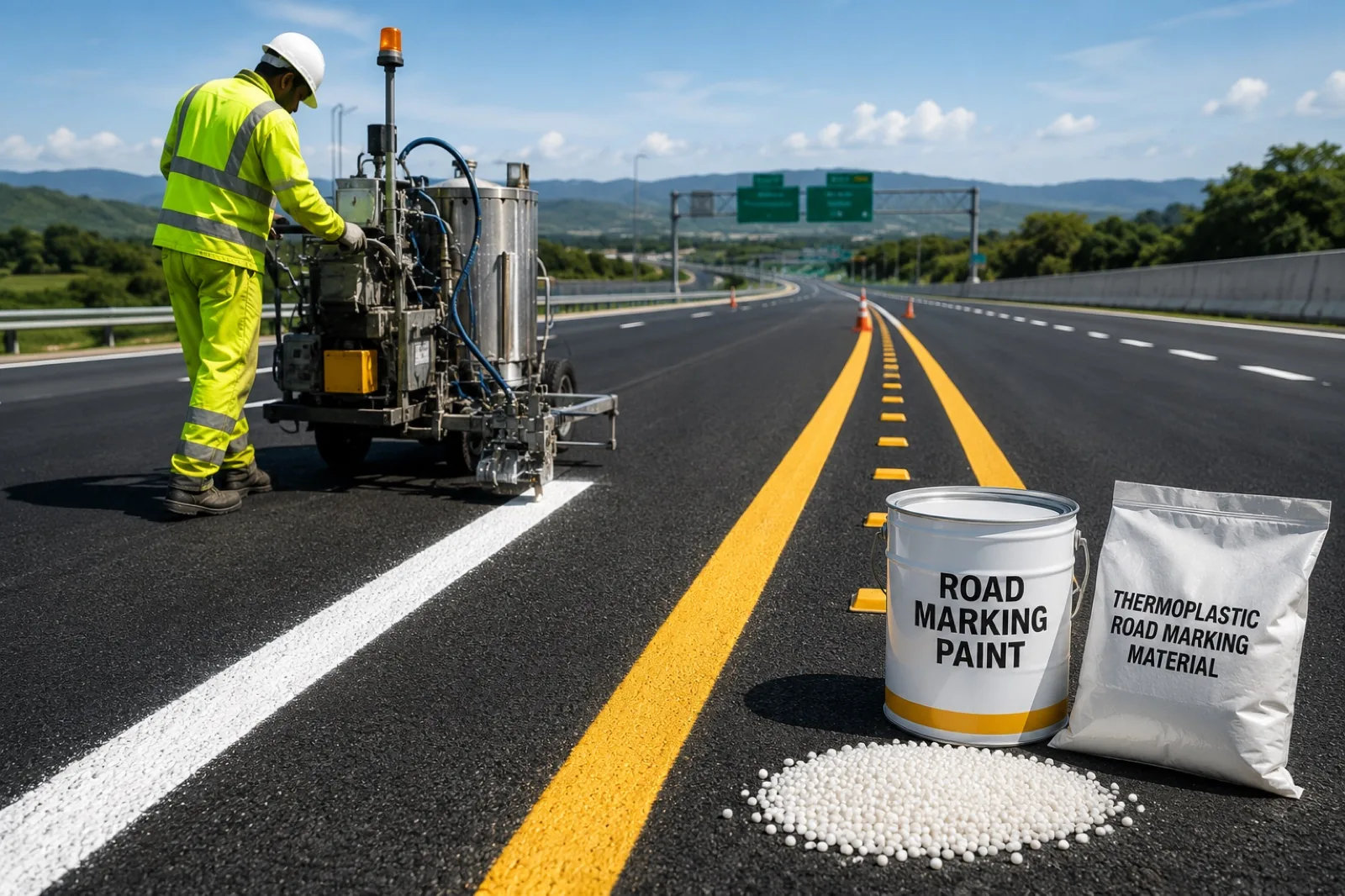
Road markings live a hard life — constant traffic, abrasion, sunlight, rain and temperature swings. The binder you choose decides how long a line stays bright and intact. For cold-applied road marking paint, one of the most trusted binders is chlorinated rubber (CR), and specifically the CR-20 grade. This guide explains how CR-based road marking works and why manufacturers rely on it.
What is chlorinated rubber (CR-20)?
Chlorinated rubber is natural or synthetic rubber that has been chemically treated with chlorine to produce a hard, film-forming resin. CR-20 refers to a specific viscosity grade widely used in coatings. In paint, it dissolves in solvent and, once the solvent evaporates, leaves behind a tough, chemical-resistant film.
That combination of fast solvent release and a hard, durable film is exactly what road marking needs.
Why chlorinated rubber is used in road marking paint
CR-based road marking paint is popular for good reasons:
- Fast drying — the solvent flashes off quickly, so roads reopen sooner and lines are less likely to pick up dirt or traffic damage while wet
- Excellent abrasion resistance — the hard film stands up to constant tyre wear
- Good adhesion to asphalt and concrete surfaces
- Water and chemical resistance — important for markings exposed to rain, oil and road salts
- Bright, stable colour when combined with the right pigments
- Good compatibility with glass beads for night-time retroreflectivity
A typical CR road marking formulation
A CR-based road marking paint generally combines:
- Chlorinated rubber (CR-20) — the binder / film former
- Plasticiser — to give the hard CR film flexibility so it does not crack
- Pigments — titanium dioxide for white, chrome yellow for yellow lines
- Extenders / fillers — to build body and control cost
- Solvents — typically aromatic solvents such as xylene and toluene
- Glass beads — dropped on or pre-mixed for retroreflectivity
- Additives — for anti-settling, flow and adhesion
Getting the binder grade and plasticiser balance right is what separates a marking that lasts years from one that cracks or wears within months.
CR road marking vs. thermoplastic
Both are common; they suit different needs:
- CR (cold-applied) paint — applied cold, dries fast, lower equipment cost, ideal for many road and factory-floor markings
- Thermoplastic — applied hot, forms a thick raised line, extremely durable, built around C5 hydrocarbon resin
Many manufacturers produce both. (See our related guide on road marking paint raw materials for the thermoplastic side.)
Sourcing chlorinated rubber CR-20 in Pakistan
Because road markings face extreme wear, binder consistency is critical — a variable CR grade shows up quickly as cracking or fading lines. Aleemsons supplies Chlorinated Rubber (CR-20) for CR-based road marking paint, along with the pigments, plasticisers, solvents and glass beads that complete the formulation, as part of our coatings and inks range.
See our Chlorinated Rubber (CR-20) product page for grades, applications and FAQs.
Producing CR road marking paint? Contact our team with your requirement and we will revert with CR-20 grades, pricing and availability.
Source these materials with confidence
Aleemsons supplies the raw materials in this article, with technical data sheets on request.